
WhatsApp Business API pricing is changing again, and this time it reaches something that used to be free: answering your own customers. Starting October 1, 2026, Meta will charge per message when your business replies to a chat a user started. This guide covers the new per-message model, what Meta actually bills you for, and what a single customer answer will cost across Latin America.
How Meta prices WhatsApp, in plain terms
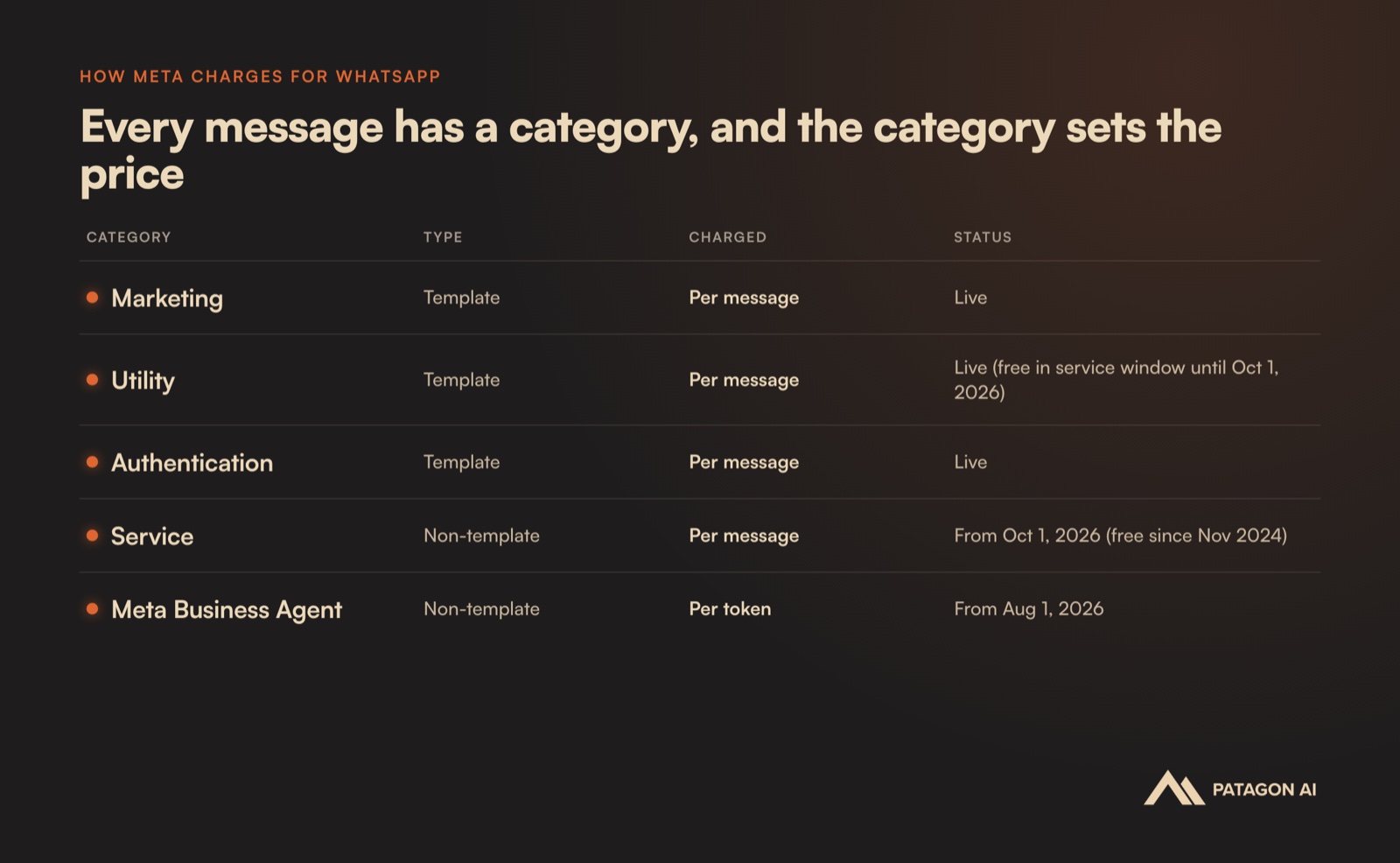
For years, Meta billed WhatsApp in 24-hour conversations. That conversation-based model is now deprecated. Today the platform charges per message, and the price depends on which category the message falls into:
- Marketing (template): promotions, offers, re-engagement campaigns.
- Utility (template): order updates, receipts, and account notifications tied to a transaction.
- Authentication (template): one-time passwords and login codes.
- Service (non-template): the free-form answers you send to a customer who messaged you first. These can only go out inside the 24-hour customer service window, which opens and resets every time the user writes.
Templates are pre-approved message formats you use to reach out to people. Service messages are the free-form replies a person or an AI writes back inside a live conversation.
Meta has also added a new category, Meta Business Agent, for replies generated by Meta's own AI. Those are billed per token, based on how much the AI reads and writes, rather than per message. Any answer not powered by Meta Business Agent counts as a service message.
What's changing in 2026
Three dates matter:
- July 1, 2026: Meta launched the Meta Business Agent Platform, its own AI layer for WhatsApp.
- August 1, 2026: Meta begins charging for Meta Business Agent messages, on a per-token basis, invoiced monthly.
- October 1, 2026: the change most businesses will feel. Meta starts charging per message for service messages, which have been free since November 2024. Utility messages sent inside the service window also become chargeable that day.
In plain terms: replying to a customer who wrote to you first has been free. From October 1, 2026, each of those replies carries a price.
What a service message costs in LatAm
Service message rates are set per market, and Meta prices them the same as utility and authentication messages. There are no volume discounts for service messages, though utility and authentication still have volume tiers. Meta will publish the final rates that take effect on October 1 by September 1, 2026, but the current per-market rates already show what a business answer costs.
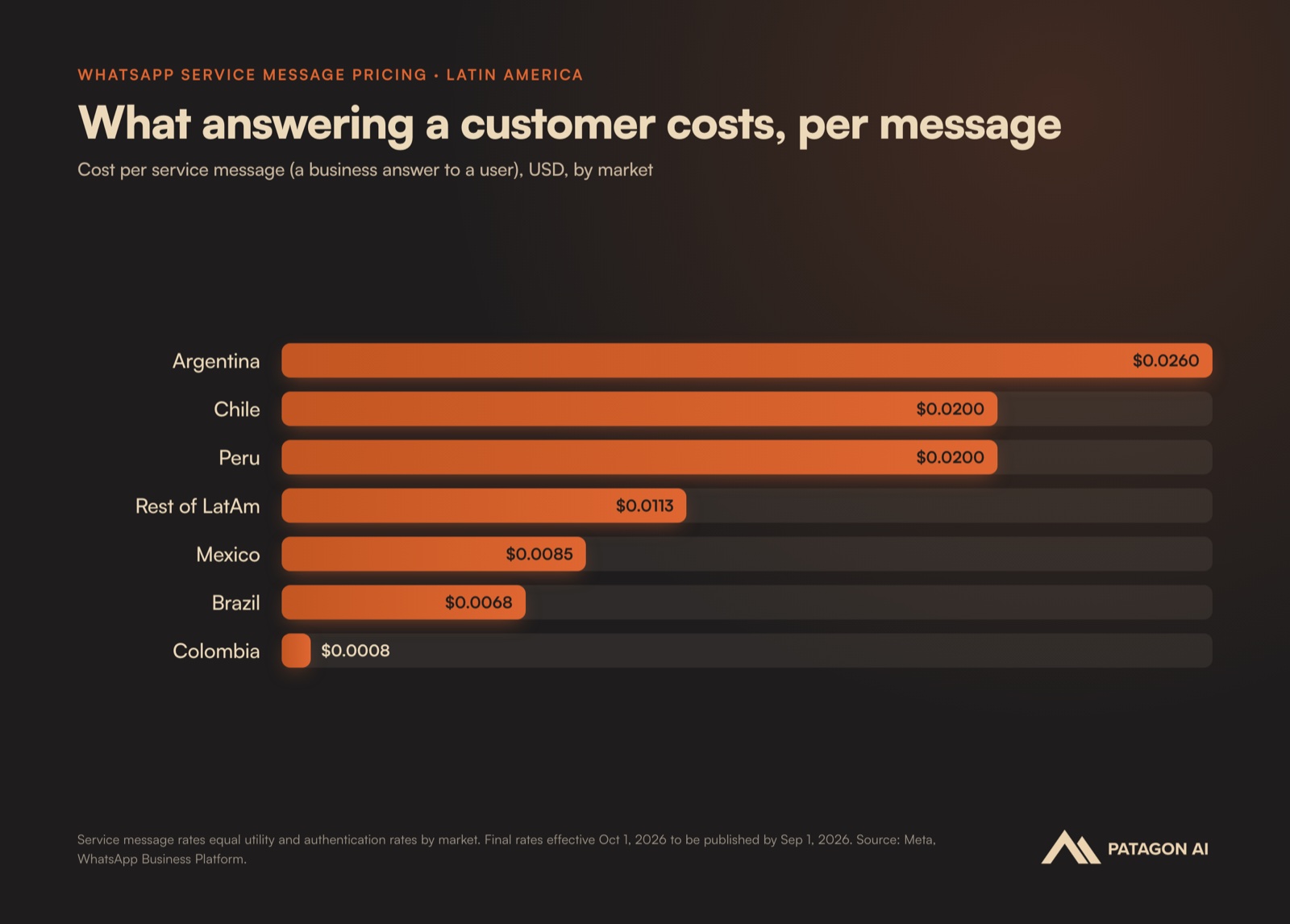
Read it two ways. In Colombia a customer answer is close to a rounding error at $0.0008. Argentina, Chile and Peru sit at the top of the range, near two cents. Even so, the most expensive market here stays under three cents per message, with Mexico at $0.0085 and Brazil at $0.0068.
What this means for your WhatsApp costs
Two things still keep the bill down. Ads that click to WhatsApp (and Facebook ads that open a chat) start a 72-hour free entry point window, so those conversations are free to answer. And until October 1, 2026, the 24-hour service window is free too.
After that, your WhatsApp cost comes down to three inputs: how many messages you send, which categories they fall into, and the markets your customers are in. A support-heavy account in Argentina will pay more per answer than the same account in Colombia. As a rough guide, a business in Mexico answering 10,000 customer messages a month would pay around $85 for those service messages at $0.0085 each.
The number that actually matters
It is easy to fixate on the per-message price, and it is the wrong number to optimize. A two-cent answer that turns a buyer into a booked meeting is cheap. A free chat with someone who was never going to buy is the expensive one, because it eats your team's time and tells you nothing about what your marketing produced.
What decides whether WhatsApp makes money is your cost per qualified lead and cost per booked meeting, not your cost per message. In LatAm, WhatsApp is already where buying decisions happen, so the channel is worth getting right. That is why Patagon AI ties every WhatsApp conversation back to the ad that created it and qualifies leads automatically, so you can see which answers turn into revenue and which just add to the bill. Businesses running WhatsApp this way have cut CAC by up to 68%.
Frequently asked questions
Is WhatsApp free for businesses?
The WhatsApp Business app is free. The WhatsApp Business Platform (the API) is billed per message by category. Service messages, your answers to customers, are free until October 1, 2026, and charged per message after that.
How does Meta charge for WhatsApp now?
Per message, by category (marketing, utility, authentication, service), plus per token for Meta Business Agent messages. The old conversation-based pricing is deprecated.
When do service messages start costing money?
October 1, 2026. They have been free since November 2024.
What is a service message?
A non-template, free-form reply your business sends to a customer who messaged first, inside the 24-hour customer service window.
How much does a WhatsApp service message cost in Mexico or Brazil?
Around $0.0085 per message in Mexico and $0.0068 in Brazil. Service rates match the utility and authentication rates for each market.
Ready to make every WhatsApp conversation count?
WhatsApp is about to cost more to run. The advantage goes to the businesses whose conversations actually convert, not the ones sending the fewest messages.
Book a meeting to see how Patagon AI turns WhatsApp conversations into booked meetings.